


Quiet Ripples × Art for Good
Featuring Amanda & Gabriel from Art for Good
Transcript of interview. Watch interview here
TEASER
Amanda: So when I first saw Chloe for her art therapy, that was five years ago. She couldn't even hold a pencil properly. Sometimes, what we want to do is empower different individuals by giving them different art projects to work on. This not only builds their portfolio, but also builds their sense of self — their self-concept and self-confidence — so that they can see that they can be more and they can do more.

INTRODUCTION
Host: Hello and welcome to Quiet Ripples, a podcast where we speak to everyday Singaporeans doing extraordinary things for Singaporeans. Today, we have Amanda and Gabriel from Art for Good. Say hi! Thank you for joining us today. Maybe we can start with a round of introductions.
Amanda: Hi, I'm Amanda from Art for Good. I'm an art therapist at Art for Good.
I do a lot of art therapy-based projects where we use art as a way of healing, as well as a way of engaging people for mental wellbeing and mental health.
Gabriel: Hi, I am Gabriel. I run the operations for Art for Good. At the same time, I work on community art projects to engage the community.

ROLES AT ART FOR GOOD
Host: Let's talk about your roles at Art for Good.
Gabriel: As I mentioned, I run the operations and the day-to-day work for Art for Good — the backend of things, like running the website and getting things up.
When there are deliveries for customers who want our products, I'll arrange and do the deliveries. I also work on our community projects — the bigger projects where we engage the community. One example is a project we did with CapitaLand for their 40th anniversary. We did a bench art programme.
They had 40 benches, and we worked with artists whose paintings were then reproduced onto the benches. These benches are now available for the public to use. Most of them are at Science Park, and I think there are nine at the National Library.
Host: Oh wow!
Gabriel: So that's one of the projects that we do.
Host: And Amanda, what's your role in Art for Good?
Amanda: I oversee most of the projects that come through and see whether they fulfil our mission — whether we are really using art to create some good. If it's an art therapy-based project, that's where I come in and lead those projects as well. I do a lot of work with children from low-income families, persons with special needs and disabilities, and the ageing population, including dementia care.
So we're working with different communities to bring together different objectives and aims, but we're really looking at overall mental health and wellbeing and how we can support that.
One of the projects that came out of some of our art programmes for those with special needs is giving them a platform to sell their artwork, as well as providing them with a portfolio. This contributes to a different self-concept, self-identity and self-confidence.
HOW ART FOR GOOD STARTED
Host: Let's talk about how you started Art for Good.
Amanda: The starting point was kind of a little bit of a kick. I was actually pretty content just serving clients and working independently.
Host: So you were doing art therapy before?
Amanda: Yes, that's right. I've been an art therapist for ten years, while Art for Good has only been around for about seven years. As an art therapist, I was freelancing and working with different organisations on my own to provide art therapy services.
One of the organisations I worked with was The Red Pencil. This is the only art therapy charity in Singapore, and I still work with them to date because I find their work very meaningful. But sometimes, art therapy is not that accessible, especially to people who can't afford it. Art therapy can cost anywhere from $90 to $200 per hour.
Host: Oh wow.
Amanda: So we can see that people from lower-income families might not be able to afford it. They then need to rely on different organisations and charities to access it. It's also about looking at how something as beneficial as art therapy can be applied to the community and made more accessible. That's how I decided that I wanted to start Art for Good. I believe it came full circle for me because, with all the different things I was doing, creating Art for Good just made sense. Of course, once you create an organisation, you need the right people to help move it forward.
I was very blessed to have Gabriel join me on this journey because this type of work is very difficult to do on your own. You need reliable, capable and compassionate people because this is not an easy journey. There are a lot of sacrifices and a lot of giving involved. Compassion and empathy are really needed on this journey.
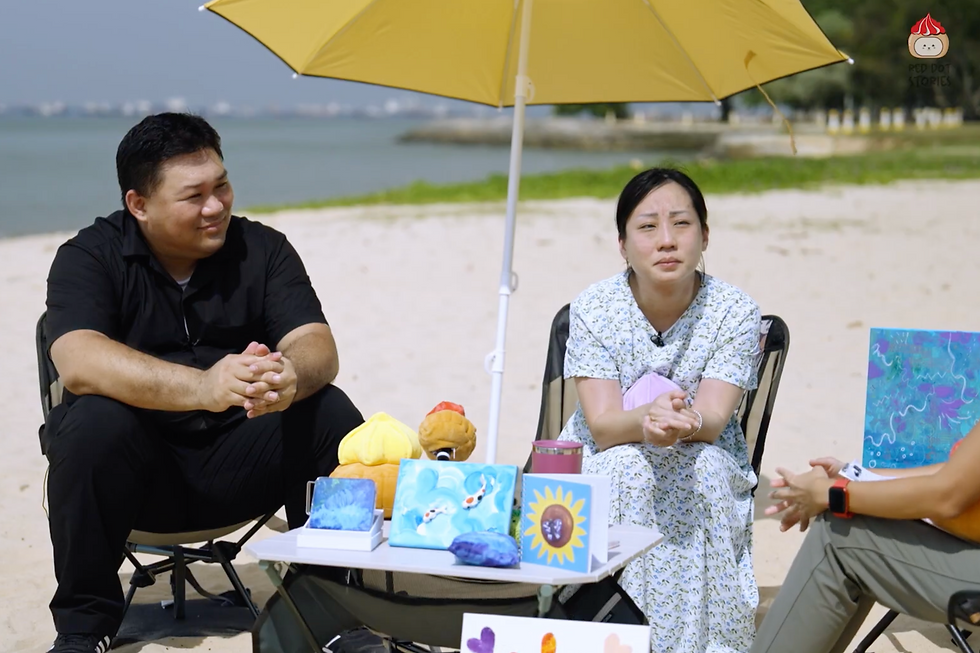
GABRIEL'S JOINING STORY
Host: So, how did Gabriel join Art for Good?
Gabriel: Prior to Art for Good, I was working for an organisation called CHARIS — Caritas Humanitarian Relief Initiatives of Singapore — under the Catholic Church. I ran a lot of mission programmes. My main goal was to run overseas missions for disasters in other countries, as well as lead teams of volunteers on these missions.
We had a programme with The Red Pencil where we wanted to bring art therapists to the Philippines to help during Typhoon Haiyan, particularly to support children and women in the affected areas. That's actually where I met Amanda again. We were church friends, and by chance we met again. I said, "I didn't know you were doing this!" She was looking at Myanmar, and I had a Myanmar programme as well.
When I left CHARIS after four years, she roped me into starting Art for Good as a charity. I suggested that instead of doing it as a charity, perhaps we could be a social enterprise. As a charity, there are a lot of rules and regulations to follow. Sometimes decisions require a board of directors, whereas as a social enterprise, we have more flexibility to make decisions. That's where I came in — looking at what projects we could do where we could function both as an enterprise and create social impact.
HOW IS ART THERAPY BENEFICIAL?
Host: You briefly mentioned that art therapy is beneficial for your clients. Maybe we can talk about what kind of benefits it provides.
Amanda: Art therapy is basically psychology using art as an additional tool that complements the therapeutic process. Sometimes it's very difficult for people to sit down and talk about problems or issues. Art can be a way to bridge that conversation. A small art activity can help people organise their thoughts and plan what they want to say before they actually say it. It can help with processing and reflection. It also depends on who you're helping.
For example, when we're working with people with dementia, we look at engagement and sometimes at tapping into different memory sources and different parts of the brain. Seniors sometimes think art is a waste of time and push it aside. But once they actually engage in the process, the outcome can be very different. They stay in the process longer, realise that they enjoy it, and add so much personality and character to their work. You can see different identities and personalities emerge. They're then able to confidently tell more stories, converse better and connect socially.
For people with special needs, it also depends on their age and level of functioning. For those who are more independent, you can do more reflective work. For those with lower levels of functioning, you may look more at occupational therapy approaches and simplifying emotions and feelings so that they can connect with the process better.
For those who are non-verbal, art can help them put meaning and communication to what they're doing. Art is a very powerful medium that enables them to do that. It's a more complex way of working, but it's also a very effective way of working with different individuals and groups who need this type of support.
Host: It's just that therapy itself, no matter what type of therapy, tends to be more expensive.
Amanda: Yes. I think that's one of the tricky situations in Singapore. Therapy is available, and there are a lot of outlets available, but there are factors like cost. I do have a mixture of different clients as well, and I think it's very important to listen to what their needs are. I find that it's most beneficial to work with different organisations.
One such organisation is the Rare Disorders Society of Singapore, which believes in mental health and therapy. They provide a budget for their beneficiaries so that therapy becomes more affordable and subsidised to some extent.

MENTAL HEALTH STIGMAS
Host: Let's talk about some of the stigmas that you face.
Amanda: Some of the stigma we face comes from clients who come with the usual taboo that we hear: "I have a mental illness and I'm going to a clinic." They worry that it's an issue or that their friends will make fun of them.
One of the ways we tackled this was by creating a studio that doesn't look like a clinical room. Instead of white walls and a hospital-like environment, we turned it into an art gallery of sorts. It's a little more comfortable, and we have a privacy screen to ensure that people walking by the studio don't invade our clients' privacy. We're also in a very quiet location with low footfall, so it's more comfortable for our clients and beneficiaries. When people come to us with personal issues, sometimes they cry. Being in a quiet, secluded and protected space helps with that mentality.
Gabriel: I think it follows a similar trajectory — that if you seek mental health support, there's something wrong with you. There has been a lot of re-education around this. It's okay to seek mental health support. But you're also working with older adults and seniors who may still feel that this is a big issue.
Sometimes, when parents themselves are experiencing mental health issues, they may push back or deny the issue and put it all on their child.
Amanda: If they don't believe in art therapy and the child does receive it and enjoys it, ultimately it can come down to the caregiver or parent who decides whether to support or stop the art therapy. It can be sad to see a child making headway and progress, but the parent steps away because they don't like the therapist or the fees.
Sometimes parents may also contribute to a child's emotional distress when they don't handle certain situations properly. That's one of the challenges where we need to educate the people supporting the child on how to better manage the situation and really help the child.
CHALLENGES FACED BY ART FOR GOOD
Host: Let's talk about some of the challenges you face at Art for Good.
Gabriel: One of the challenges is that, because we are a social enterprise, we lose out on some projects because we don't fall under a nonprofit or charity-type service. Sometimes organisations want double tax exemption or require us to have IPC status. Therefore, they won't purchase some of our products because we don't fall under that category.
That's really sad because we still fall under the category of trying to create good and social impact, and trying to help different individuals, including people with disabilities. Just because we are not a charity doesn't mean that we are not creating good. It's a big challenge to overcome because of that type of stigma as well.
HOW ARE ART FORMS DECIDED IN ART THERAPY?
Host: Let's talk about some of the art forms that Art for Good provides.
Amanda:It's not so much the art form itself that's important in art therapy. A wide range of art mediums can be used. The goal and objective is mental health and mental wellbeing.
There are therapeutic elements in the actual art-making process, but if you're talking specifically about art therapy, it's more attuned to emotional wellbeing, mental health and mental wellbeing.
A lot of the directives and art-making processes are geared towards that approach. The art therapist would recommend what types of mediums should be introduced and how they should be used. Especially when working with persons with disabilities, we consider their limitations and suitability. Would this aggravate the client, or would it create more calm? That's where knowledge of the art mediums and the client comes into play — understanding what would be helpful rather than harmful.
MEETING THE ARTISTS
Host: And with that said, you actually brought us some amazing artwork from your clients.

Janelle's Artwork
Amanda: This one is actually done by Janelle. She's one of the Rare Disorders Society of Singapore beneficiaries who has undergone the art therapy programme. She is bedbound, which means she can't leave the bed, so the type of art she can do has to be more simplified. She wanted to create something on canvas, and she actually created three pieces. What might seem very simple for us can actually be quite difficult and quite a feat for someone like Janelle.
This piece uses stamping and stencilling. The way she positioned the elements so that they look like a flower was also very creative on her part.

CHLOE'S STORY
Amanda: This is Chloe. For her, she did a mixed-media piece using clay fish and an acrylic-painted background. She likes pastel colours and, nowadays, she's really into a water theme. This is one of the more recent works she's created.
Chloe has spinal muscular atrophy, where there is muscular degeneration throughout the body, particularly affecting areas such as the legs and spine. She's wheelchair-bound, so a lot of her artworks are small and cute. She does a lot of detail and works on a smaller space.
She also does crochet.
We managed to get her a project with the National Library Board, which has a section focused on making libraries more accessible to persons with disabilities. They have a mascot called Iris, which is a purple heart. Chloe was commissioned to make 70 purple hearts.
Recently, Chloe had an operation on her spine, so she couldn't sit up and do a lot of things. She also had a two-month break from school. One of the things she really got into during that period was crochet. So she was really using art as a way forward for healing, meaning-making and also getting a project to work on.
Sometimes what we want to do is empower different individuals by giving them different art projects. This not only builds their portfolio, but also builds their sense of self — their self-concept and self-confidence — so that they can see that they can be more and do more.
Amanda: When I first saw Chloe for her art therapy, that was five years ago. She couldn't even hold a pencil properly. A lot of these things also include elements of occupational therapy — having the motivation and desire to be creative and work with your hands. But art-making itself can be really fun and motivating, and that really worked out for Chloe.
Chloe's Journey
Host: I know you said you start with an eight-session plan for most clients, right? How do you assess whether someone might need more sessions? Chloe has been with you for five years now.
Amanda: We actually work on different goals. There are different stages, what we call life stages, where people need different types of support. For Chloe's initial engagement, it was her transition from kindergarten into primary school. There was concern about how she would manage the change of environment and how she felt about it. As school progressed, we continued to support her through that journey and provide emotional support.
Her love for art was one of the things that kept her going. I think what worked for Chloe is that because she's in a wheelchair, it's not as accessible for her to move around. Usually, children can go for art classes, dance classes and other enrichment programmes.
For her, her choices were more limited. Having the therapist go to her and provide that support made it easier for Chloe to continue with art therapy for a longer period of time.

TITUS' STORY
Amanda: This art piece is by Titus. Titus is the youngest of three children, all of whom have special needs. Titus has a rare disorder — an immunodeficiency disorder — which means he needs regular treatment because his immunity is low. He recently had appendicitis and was hospitalised for almost a week. He created this piece before his hospitalisation.
Titus has a keen interest in music. He loves playing the flute and also plays the piano.
One of his favourite pieces is River Flows in You by Yiruma, and he titled this artwork after the piece. The colours and flowing elements were inspired by the music, and he also included music notes from the actual score.
So this was a musically inspired piece and one of his favourite works. This painting is also available online for people who would like to support him. The proceeds go directly to the families. We take a small portion to cover delivery and other costs we've incurred, but the majority of the funds go to the families.
TURNING ART INTO PRODUCTS
Amanda: This sunflower piece is also by Titus. We have different corporates who adopt different projects. They adopted this piece and a token sum was given to Titus. This one was adopted by Acuvue.
We also have many people who support artists with disabilities by printing their artwork on different merchandise. For example, we have this artwork by Titus' brother, Lucas. These are blue flowers that he painted for his mum. We turned them into two coasters and a small eco bag, and these are available online.
Host: One of them actually felt a very big sense of achievement when he sold his first one.
Amanda: Yes. He was actually very sad for a long time, asking, "Why is no one buying my things?" But we can't control who or when people buy things. So when you make a purchase, you're also making one child really happy because they've sold their work. I think it's very empowering for the children, especially because they've already gone through so much. That little achievement can be very empowering. That's also one of the reasons why we decided to do this.
It's not so much about creating a money-generating machine, but really about building that sense of empowerment.
THE RIPPLE EFFECT OF ART FOR GOOD
Host: With all that said, what do you think is the ripple effect Art for Good is creating in the community?
Gabriel: I think one of the things is that, because we work with children with rare disorders, we're trying to create a sustainable programme for them. In the past, caregivers may take full care of these children. But if there's a change in caregiver or, eventually, the caregiver is no longer around, how does the child, when they grow up, get sustainable income for themselves?
I think we're starting to help through simple things — keeping them paid and providing a platform for them to sell their artwork as a stepping stone. Hopefully, it motivates them to run a business of their own or find partners who can work with them to bring it further.
That's where I think we're going.
Amanda: For me, when I think about the ripple effect, what comes to mind is that once you help an individual with their mental health, emotional wellbeing and overall wellbeing, they become better able to participate in the community and contribute to society. That creates a ripple effect.
If they're able to be in a good headspace and a good space overall, there is a certain wealth that comes with good mental health. It benefits not only the individual, but the group, the community, society and then the world. Looking at it as a bigger ripple effect, we might be very small. We're like that small pebble being thrown into the ocean or river.
As long as we help even one individual, that can be a catalyst to make a difference.
WHAT KEEPS YOU GOING?
Host: We've talked a lot about how you support your beneficiaries. But what keeps you going?
Amanda: One of the things that keeps me going and motivates me is seeing how people actually glow and grow from this whole process. You can see when somebody receives that unmet need that they're looking for, there's suddenly a whole change in their demeanour and physical state because their mental state has changed as well. Sometimes, a simple thing can generate such a big change.
When you see that in the face of the person you're helping, I think that's something that really motivates me to be part of this — helping people so that they can benefit and help others. It's like you uplifted them so that they can uplift you.
Gabriel: For me, I have this motto that I saw when I was very young: "Never look down on someone unless you're helping someone up." I believe in that very strongly.
When I was a younger kid, I had school peers who bullied me, and it was another peer who helped me out of it and got me going. So for myself, it's really about helping others. Sometimes I'll get to a wall and I don't know how to get past it. It's very uplifting and encouraging when somebody else comes to pull you up.
THE FUTURE OF ART THERAPY
Host: It's nice to have seen the art therapy scene grow over the past ten years. What I'm hoping to see is, of course, art therapy becoming more robust in the scene and more accepted as a profession. Rather than being seen as art teachers or someone who provides free art services, I hope it is recognized as a profession that genuinely helps mental health and wellbeing. And of course, you need a community of people to do that. Sometimes it just takes one or two individuals to start something, and hopefully the scene will look brighter and continue to improve, as it has over the past ten years.

OUTRO
Host: Thank you so much for joining us today on Quiet Ripples. And if you like our content, remember to hit like, share and subscribe. This is once again Art for Good.
If you'd like to learn more about them or purchase products made by their beneficiaries, their website and social media handles will be here. That's it from Amanda and Gabriel.
Thank you so much for spending so much time with us under this nice, warm weather today.
And we'll see you next time!


